The Artist as Tortured Genius
Wednesday, January 5, 2011 at 10:41AM
Image from http://www.wiw.pl/biblioteka/muzyka_cook/04.as
What really pisses me off is this idea that I am this tortured artist. That is something based on flimsy evidence which is endlessly being projected back onto us. It is just reductive and dull. In order to be creative there has to be a distance from you and the thing itself. It is only when the distance gets confused that things go wrong. If you actually start to believe that you are what you write, then you have f***ing had it. You have had it and you ain't coming back. To assume that everything is about somebody's life is to assume that that person is inherently stupid and isn't capable of absorbing anything else. The whole point of creativity is that you spend your whole life absorbing things almost to where it is unbearable. The way you deal with it is (to) get out.
-Thom Yorke of Radiohead, in an interview with Pulse, quoted in Kid A by Marvin Lin.
The media has created an image of Thom Yorke as tortured artist and genius. They have done this with a wide range of people, from Phil Collins to Mozart, and are moving beyond Beethoven to others like Schubert, and including performers (Glenn Gould comes to mind, as does the craze around David Helfgott when Shine came out about 10 years ago).
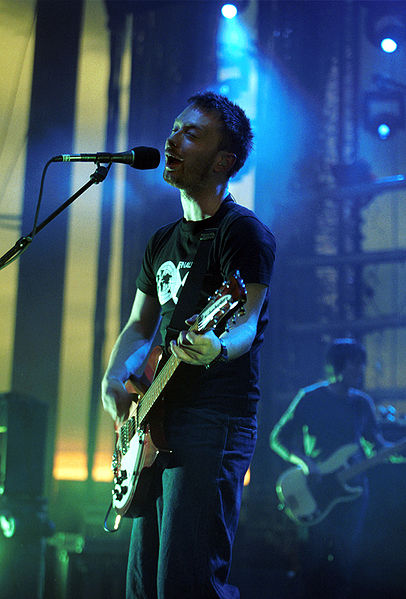
By Goldberg ((Goldberg)), via Wikimedia Commons
Do we need to have this mystique of the artist/performer as a tortured soul to help explain their music, to give it some authenticity? Why are we continuously attracted to this story, even though historians have shown that Mozart and Beethoven, for example, weren't as tormented as we believe?
Lady Gaga has said that "Music is a lie. It is a lie. Art is a lie." Is that any different than what Thom Yorke said? Should we, as artists and performers, believe that art is a lie?
Share your thoughts below!
Related post: Is Lady Gaga Wrong? (Is art a lie?)
Andrei
(Apparently I can't respond to individual comments on my blog, or I don't know how, so until I figure it out I'll post responses as a follow-up entry.)
Matt brings up a very good point about Thom Yorke lashing out at the interviewer - he is an enigma, and tries to keep himself so, which probably leads to the media covering him more and creating a persona, since he isn't creating one himself. Perhaps he's not the best example to use for this topic.
Regardless, Wayne brought up a good point, too: "the work gets done." Art gets created, performed, viewed, read, no matter how exactly it happens (and we can't always trust a composer's account of things, and John Adams recently pointed out).
I think that what I perhaps intended to address, or at least suggest, was that the media feeds on images of tortured artists - and I can get caught up in them as much as the next person - but there are plenty of incredible artists in any field (music, visual, literature, etc.) who don't fall into the idea of tortured genius, and I don't think it's a "requirement" to be a successful artist.
To start down a different path, perhaps this is a reason why artists such as Beethoven, Sylvia Plath, Jackson Pollack, et al, have been so revered: not simply because they've produced great works of art, but because their personal story (or at least what we have created that story to be) is intriguing and gives their art an element of "other-worldliness." We get the idea that we should be so privileged to have a window into their life, that's so different and separate from the "real" world that the rest of us reside in. It's connected to Matt's notion of "transcendence" in his comment about a Darcy James Argue piece. If an artist was able to transcend their personal struggles to create something enduring, perhaps we can do the same.
I brought up quite a few ideas and tangents here, and might be making myself less-clear instead of responding and clarifying, but that's how it goes for now.
Thanks for the conversation!
Andrei |
13 Comments |
Beethoven,
Kid A,
Lady Gaga,
Mozart,
Radiohead,
Thom Yorke,
aesthetics,
authenticity 


Reader Comments (13)
I'm sure there are some of the "tortured genius" ilk,Andrei. But the media loves stereotypes. It isn't totally w/o foundation, however. We see and hear things differently than the left-brain contingent. In that sense, we *are* "crazy artists." Since I'm in both music and graphic art, I know people are amazed that I can, say, tell someone what note a squeaking door is making. Or make an image rise out of a page with a pencil, or brush. I've never felt tortured, or genius for that matter. I just do these things because I have to,much like breathing. Let people say what they will.
%%robert, aka chopin_slut
I am not of the opinion that great artists need to be tortured geniuses and I agree with Robert, that the media feeds on the sensation that is caused when some dramatic story is brought forth about an individual. There are plenty of tortured souls and geniuses that have nothing to do with the arts. I see the more successful artists as being passionate, yes, and driven, yes. They tend to have a focus that is unusual for many and also an incredible gift at seeing what is possible which is somewhat of a rarity in everyday life so perhaps it just baffles people so much they feel like they have to find a reason behind this type of passion. I believe everyone could be seen as tortured if we looked and analyzed enough but what's the benefit in doing that? We could just as easily look at the same group of people and see them as outstanding individuals. I'm a "glass is half full" type of person so that's how I prefer to see it. :-)
Thanks for bringing up the question...interesting.
-Erica ( @ericasipes )
"Glass is half full...."
What glass?
<g>
%%robert
You don't have to be crazy to be in this band. But it helps. I would agree with Robert's comments. For a middle aged, Right-handed white dude, I'm pretty left-brained. As such I react much differently than the "norms" to various stimuli. I don't know any "norms" for example that will stop in their tracks to listen to a piece of music. I don't do that for everything I hear, but there's some stuff that if shuffle brings up all other activity ceases. For the first time, I heard a track off Darcy James Argues Infernal Machines on Tuesday and time stood still. I don't think many other people react like that to art. I pity them.
Now, can music or art make you bonkers? Physically I don't have the answer to that question. Environmentally, perhaps. Mingus and Pastorius both did stretches at Bellevue. Nathaniel Ayers is another bassist who became mentally ill. Do I simply lack the talent needed to be driven insane by it? I don't think so. But clearly, there has to be some chemistry in our brain that makes us different. Can that chemistry pre-dispose us to mental illness?
I may not be clinical, but certainly this world torments me. In some way Thom Yorke is also being tormented by very virtue of his lashing out at the interviewer.
Near the end of her career Marguerite Young returned to writing poetry. Asked why she answered "Because I know how to do it." I believe that within the turmoil and passion of a "usual" life much great art has come forth from a mental quietude in the exercize of a practiced proficiency. The work gets done. With or without the documentable agonies of a given life, the art comes forth. And the individual composers differed in their chosen style of being the drama queen at the core of such a purple passion. Beethoven was often quite loud. Chopin was excessively unostentatious. Mozart was a master at hiding everything. Bach always did manage a piety even at his most robust. Handel so consistently sublime. Each had his way of it.
That's my take.
Thanks for giving me this opportunity to address this issue.
Wayne
I really like everything that's come in. A BIG tnks to Andrei for getting this going. Should do more of it...and get even more people on this thread!!!
%%robert
Hey Andrei, sorry for the delay in commenting - I wanted to have a proper think over the issue.
There are two big issues here, so I'll comment on them in turn.
The first issue is the one of tortured artist. I think this has been fairly well covered in your update.
Society tends to like something out of the ordinary - supernatural or superhuman - something to distract from the
mundanity of everday life. You see that in a lot of things, possibly most currently the popularly discussed 2012
'end of an age'/apocalypse prediction. People want a superhuman Mozart perhaps also as some indication of the divine,
or some evidence of a greater power. The true story is that Mozart was brought up in the perfect conditions for a
musician to thrive, worked extremely hard all his life, including his childhood, and right up to the week he died.
You can probably add to that a massive natural talent for music (completing both halves of the nature/nurture seesaw)
and maybe a bit of that genius x-factor that so few are blessed with. Even in Mozart's day, he had some of this
superhuman aura around him - Haydn said on Mozart's death that another composer of his stature wouldn't come for another
hundred years (which Beethoven disproved of course). Then the Romantic era began to mythologise Mozart's life, and,
especially, his death. What we have today is a hangover from this period, where Mozart became a god-figure - a god of
'light and grace'.
The tortured artist persona probably applies best to Beethoven out of all the composers, since he lost that faculty
most indispensible to a musician - his hearing. He also began to lose it fairly early in his career - when he was in
his early 30s, soon after he published his first opus. This, even more than Mozart's extraordinary life and death,
gave something for the romantic era to latch onto - his apparent struggle against fate, and ultimate triumph (the
apotheosis of which is often seen as the 9th symphony).
To get to the point, not much of Beethoven's life needs anything added to make it fit the romantic image (although
much surely was). Beethoven's stark individuality, deafness and overcoming of it, his towering symphonic output, etc.
are all the plain truth. Beethoven suffered much for his art, as far as we can tell, and for my money, just about
everything Beethoven wrote was a genuine outpouring of himself - a sincere representation of his inner being.
This contradicts Yorke's point that there must be a distance between the artist and the artwork. To be sure, not
all art is about the artist's life - and suggesting that would be childish and indeed 'reductive'. That doesn't
preclude various different pieces of music in many different moods or styles all having an inherent truth for the
composer.
There's no reason to believe, even if Yorke is to be taken at his word, that he has the same working methods as,
say, Beethoven, or the archetypal tortured artist.
The second point is much less straightforward, and one I'll probably only try to discuss briefly and tangentially.
"Music is a lie. It is a lie. Art is a lie."
I haven't read your article on this yet, as I want to form my own thoughts first, but I'll read it after.
At first, this appears to be a shock statement with little thought behind it. It echoes Wilde's "All art is useless"
from the preface to The Picture of Dorian Gray, but one suspects less thought was put behind Gaga's words.
As I said, I'm tackling this tangentially, just for a different approach, and because I have no context for the
quote. It could first be asked on what authority is Lady Gaga making this statement? Where does Gaga rank in
the pantheon of artists, and what weight should be accorded her words? How seriously would we take this
statement if, for example, Britney Spears had said it in her heyday a few years ago? I'm deliberately
not answering any of these rhetorical questions since it's not for me to decide; but it's worth thinking
about.
Let's take a look at the first statement: "Music is a lie."
It's hard to know what this even means. What music? What lie?
For music to be lying, it has to be trying to tell something. Stravinsky infamously said that music is powerless
to communicate anything, and although he later recanted, and I don't consider it to be true, it has a kernel
of, if not truth, then sense. Absolute music is a series of tones - vibrations of air - put together in a
way the composer likely thought was meaningful. By its very nature it almost never tries to communicate
anything extra-musical (which is possibly what Stravinsky was referring to). If it is lying, then, it must
be contradicting some internal, purely musical truth. This is far too intangible to be discussed within the
scope I have here - also I don't think that's what Gaga referred to.
Music with lyrics is another issue - a much more obvious one, which I don't need to delve into.
The other possibility is that Gaga simply refers to music (and art) as being a construct - something created
by humans which doesn't exist otherwise, and can be somewhere to disappear into - a form of escapism. But that
is just a butchering of English, whereby you could call your summer cottage a 'lie' because it was man-made
and doesn't affect your daily life. I'm hoping this simplistic view isn't what she meant, but it's the
most straight-forward of the options. 'Art is a lie' sounds controversial, gets us discussing Gaga (probably
what she wanted to happen) and goes against the accepted notion that art contains an inner truth, or reflects
the world in some inherently true way. Her going against this would be extremely simplistic then, simply
commenting on art's obvious, long-accepted nature of being an abstract man-made construct.
Apparently controversial statements like this tend to pop up every so often, as the Wilde example noted before
(although it seems to be rather more meaningful and thought-provoking). When the first camera was invented,
a notable painter of the time (early 19th century) proclaimed "painting is dead!" I find Gaga's comments
have about the same weight and bearing as this!
Definitely good to provoke discussion, though - that's the best way to define your own thoughts on such matters.
Interesting post - thanks.
Daniel
The image of the tortured artist strikes me as little more than a fad. It may be long lasting, but I don't see any inherent reason why it should be theimage of choice rather than something else. It's attractive because it's romantic. It may have staying power because of the fact that artists, as societies commentators, necessarily stand somewhat apart from society. Thus they are perceived as "eccentric." It doesn't strike me as a big leap to get from "eccentric" to "tortured."
Grant Charles Chaput
@GCComposer
KillingClassicalMusic.com
The idea of the tortured artist has never bothered me (see Vincent Van Gogh). I think it can certainly get over-exaggerated, but I think it's still there. I like what Grant said about the difference between being eccentric and tortured. I don't think I've ever known an artist that I considered to be tortured (though I've known a couple who I think are on the fence), but I've known tons who are very eccentric. They couldn't and wouldn't be as good at what they do if they weren't that way.
I promise you that I am the farthest thing from a Star Wars sci-fi geek there is, but I think of it in terms of metachlorian count (I just had to look up that word to see how to spell it); you know, those cells that are inside the Jedis to varying degrees that dictate their ultimate ceiling for power? Sort of like talent, but probably with more social and personal baggage. Darth Vader's metachlorian count was off the charts. I know he's a fictional character, but I think it's fair to say that his ridiculously high metachlorian count was ultimately something that tortured him. I fully believe this to be true of artists as well. It's so rare to find an artist (in the classical, "art" sense) with a high metachlorian count that can make profound connections with "normal" (non-artistic) people. And the higher our musical metachlorian count is, the better the odds are of us not seeing eye to eye with others because we are so incredibly different than them. As a musician like yourself who is probably surrounded by talented, skilled and profound artists on the daily, it's easy to get desensitized to just how truly unique you are in the grand scheme of things. Maybe you're not tortured (I don't know), but you are without question unique. The world's view of tortured and your view of tortured are clearly different, but I say let them have their view.
As for people who aren't musicians who are tortured, I have a theory: they are artists as well; they just don't know it yet, and they desperately need an outlet for meaningful expression.
Music is a lie, Lady Gaga? Really?! If music is a lie, then I'm quitting right now. Being "tortured" or "eccentric" for nothing is a waste of time.
Thanks for the post. I enjoy your blog.
Travis Branam, aka @musicapologist
Miles Davis once said in an interview something to the effect, "this assumption that you have to be poor downtrodden and black to have struggled to be able to play the blues and jazz is a crock of shit, I never and never struggled, my daddy was rich and my momma was good looking."
thank you verry much sbobet 7m
7m
ผลบอล
very well,All things in their being are good for something
sbobet
sbo